Eleanor Levie HomeAboutEditorial ServicesBooksGallerySpeaker TopicsWorkshopsPast BookingsFree StuffLInks Contact Me

Inspiring Quilting: Elly's blog to boost your creative IQ

Archive for August, 2019

Bodil Gardner’s Ladies

Sunday, August 25th, 2019

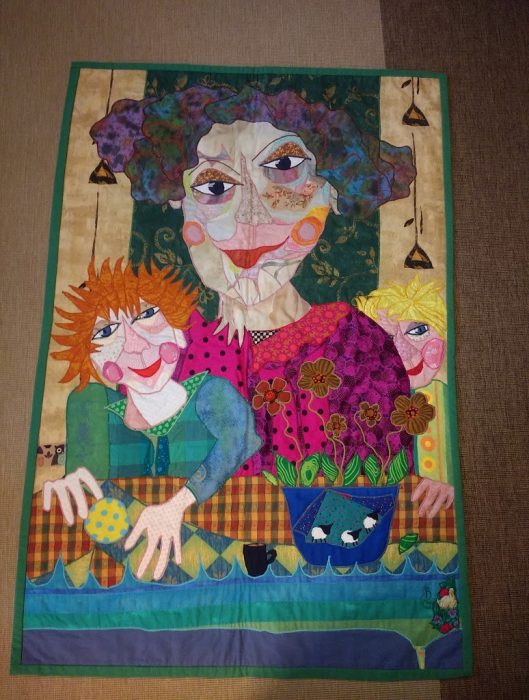
“I’m just a simple housewife,” she asserts, when I ask Bodil Gardner, if she calls herself a fabric artist or an art quilter. In fact, she is an international star of the quilt world beloved for her disarming, quirky masterpieces. “I just make my pictures, she says.” Her modesty is typically Danish.

As she explains on the website her husband, Peter put together for her, “I have not had any artistic training and was brought up to be the practical one in a creative family, which needed to get the washing-up done. Are my pictures art or not? The question is frequently asked. For me, it doesn’t matter what they are. I make them for my own sake, hoping all the same that you will also like them.”

I have invited myself over, finding myself in her vicinity when the husband and I are visiting our son and his wife in Aarhus, Denmark. My daughter-in-law, Bev, volunteers to drive me over to the suburb of the city, where Bodil and Peter live. “Drive up the road through the garden,” are her emailed instructions, which turn out to be quite the understatement.
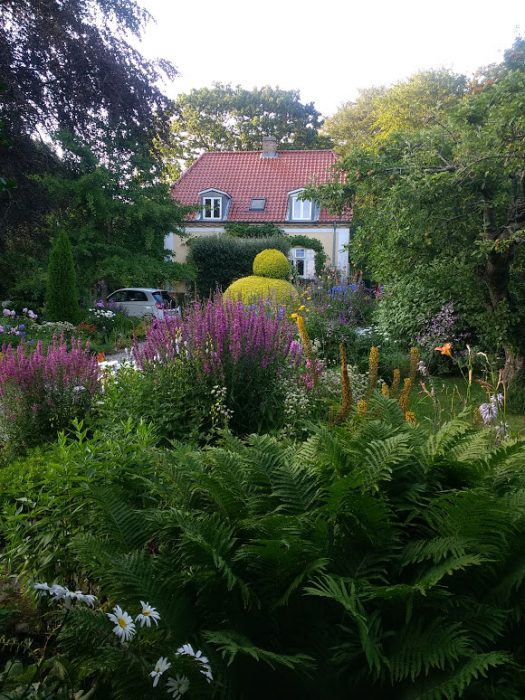
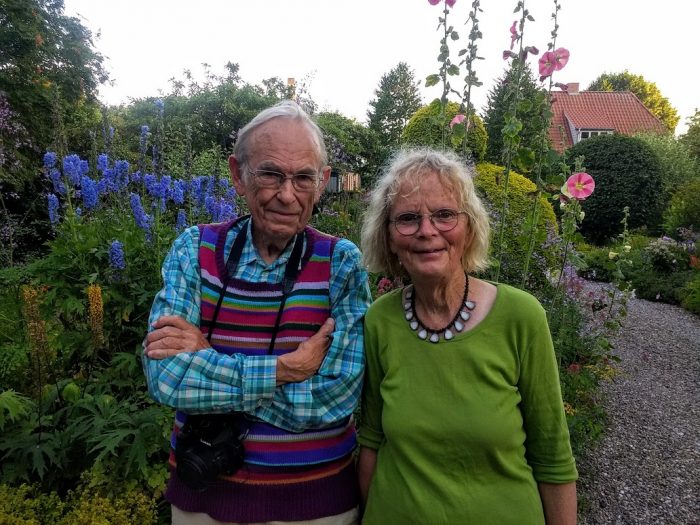
As you can tell, Bodil and her husband live up to their surname, Gardner. Like Peter, the garden style is English, transplanted and intermixed with Danish determination. The warmer seasons are mainly for gardening; winter is when Bodil devotes herself to working on “her pictures.” Playing with colors and patterns are the common source of joy.
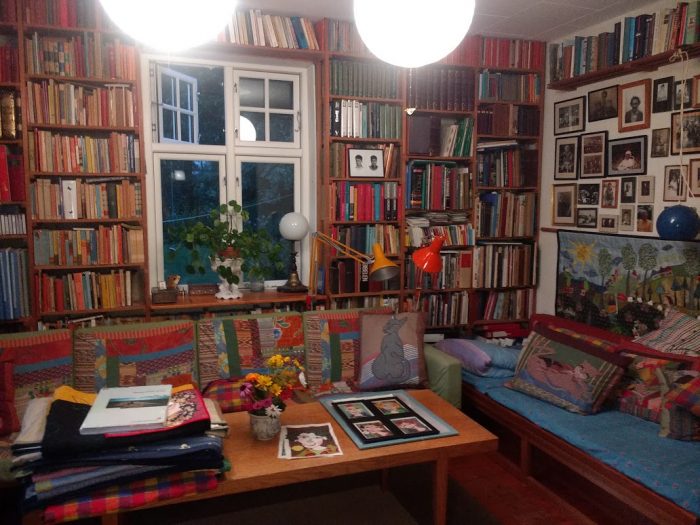
Bodil doesn’t have a “studio,” and when we visited, we sat at a dining table where she served us homemade apple crumble, with danishes and chocolates and tea. We brought a bottle of red wine, and a packet of various fabric prints. An old, portable sewing machine under its cover sits on the shelf behind the table, and there’s a jumble of fabric scraps on a trunk beside Peter’s computer table. Otherwise, no sign of a work space. Past a large archway, you’re in the sitting room, where appliquéd pillows and patchwork command the lower planes, and books and photos fill the walls from floor to ceiling.
After dessert and far-ranging discussion, Bodil displays some of her pieces the same way she composes them: on the floor.
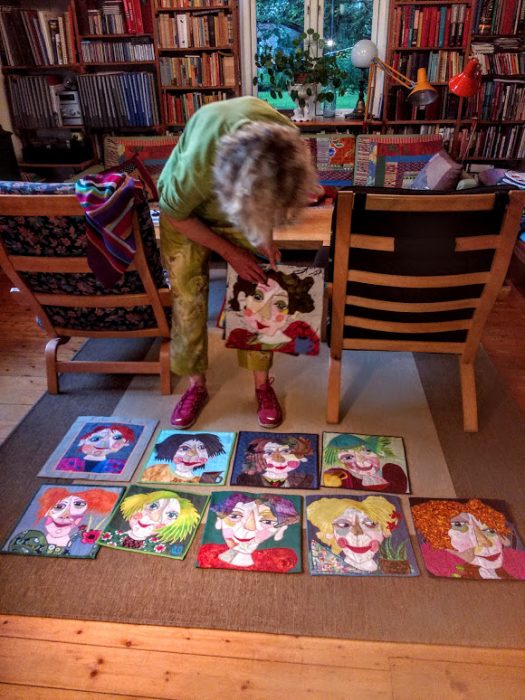
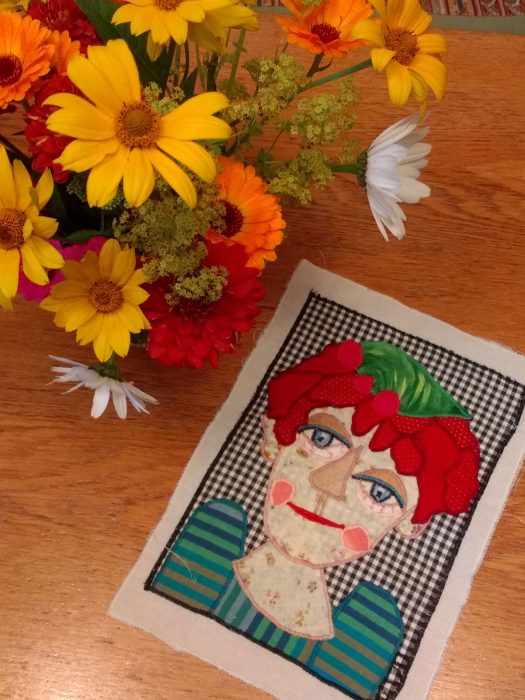
Lots and lots of delightfully funky portraits. Like Joni Mitchell’s Ladies of the Canyon, Bodil points out, each one has a unique personality. Fabulous hairstyles, flower accents, funky colors. Friends bring her fabric, and she uses what she has. No fusible web for her. She chooses from her assortment of scraps, cuts each piece freehand, assembles elements as she goes on larger background pieces, pins pieces to secure them in place temporarily. Only when she is satisfied with the entire composition does she moves to the sewing machine to satin-stitch over all the raw edges. Quilting and finishing details are minimal. Larger works elaborate on women at home, of generations, taking tea, counting sheep, gentle pets, and children, either confident or shy.
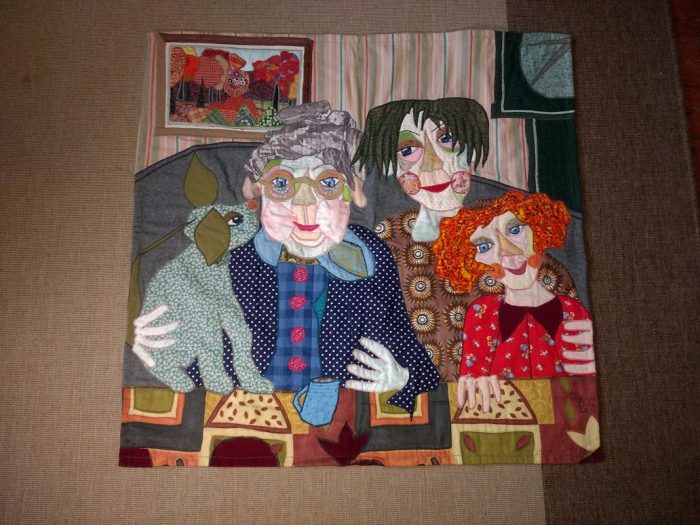
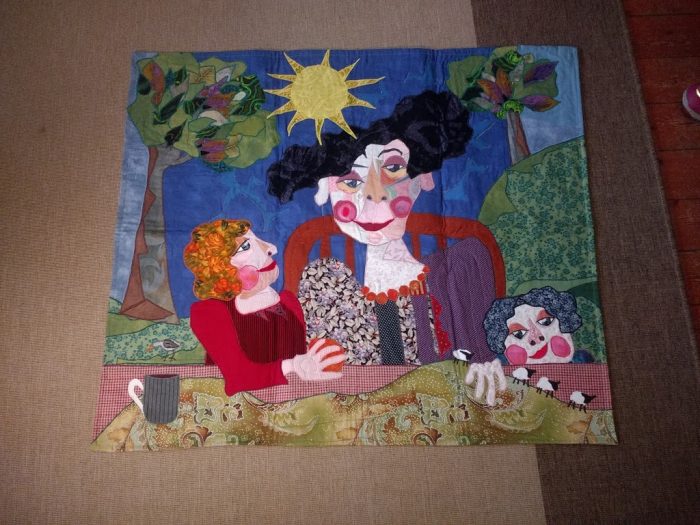
It’s easy to recognize a Bodil Gardner art quilt, isn’t it? And to feel the warmth and friendliness, and yes, a bit of zaniness embodied in each and every one. Far from quilt shops, shows, classes, she retains her own signature style, and doesn’t travel far, so relatively few students can learn from her way of working and her genius for face values, so to speak. Pamela Allen of Canada got her to join the Studio Art Quilt Association (SAQA), and Peter Gardner encourages his wife to respond to more of their calls for entry. Her work has been showcased in many top-drawer, juried exhibitions, within and outside of Denmark. But in many cases, a juror chooses a cohesive collection of sophisticated abstract and painterly tour-de-forces; Bodil’s pictorials stick out as being too different, and so don’t make the cut. That was the case when Bodil entered the piece below for the SAQA show for which the theme was Tranquility. Her reclining woman with cat, book, and teacup didn’t make it into the exhibit….yet SAQA saw fit to feature the piece on the cover of their magazine.
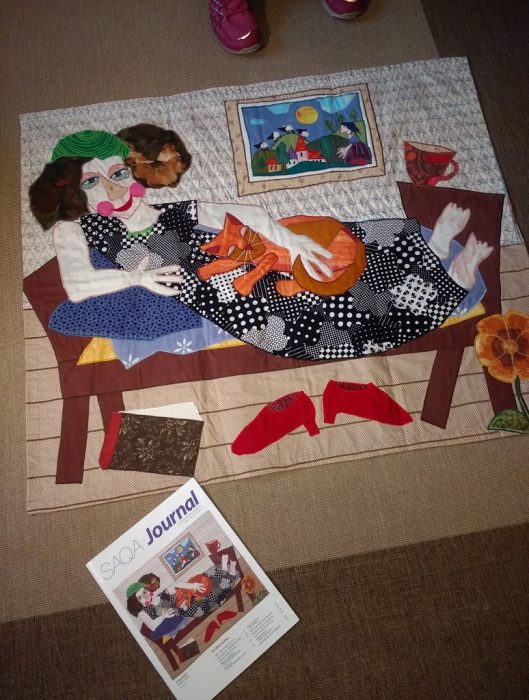
There’s not a whit of pretentiousness in these portraits of wise, nurturing women. I can easily imagine each one a sort of self-portrait…the alter ego of their maker. There are probably hundreds of them, a treasure trove of joyful folk art, with many more to come from from Bodil Gardner.
Favorites from Gees Bend

Wednesday, August 14th, 2019

As admired in the exhibit, Souls Grown Deep, at the Philadelphia Museum of Art.

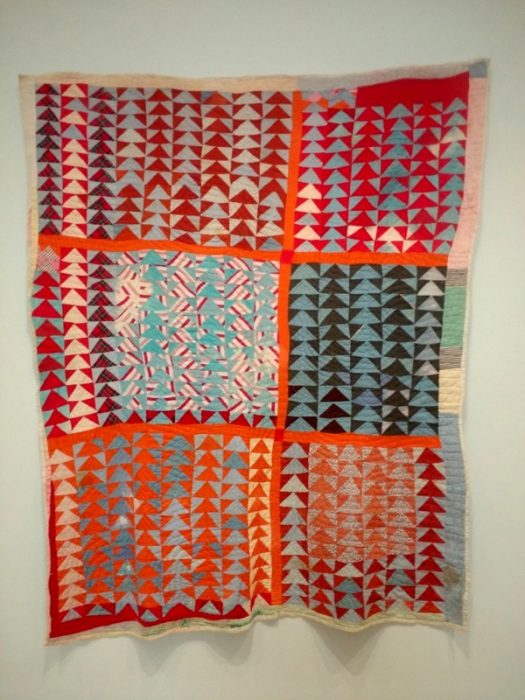
Housetop/Fractured Medallion Variation, Delia Bennett, 1955

Gee’s Bend is a small, poor, black community in Alabama. It’s only 44 miles west of Selma — where in 1965 Martin Luther King, Jr. led protest marches to Montgomery, Alabama. But surrounded on three sides by the Alabama River, Gees Bend is isolated, a far cry from modern-day consumerism and attitudes. Most of the 700+ folks who live there are descended from slaves. After the departure of Joseph Gee and the dispersal of his slaves, the Pettway family ran the plantation. In order to stay on this land, many of them had to take on the Pettway surname. Sharecroppers and tenant farmers kept workers in poverty. Planting and picking cotton, peas, and peanuts, and tending hogs and cows provided long, hard days of bare subsistence farming. But poor by any standards, generations of Gees Bend women have created a rich legacy of quilt masterpieces. And these have garnered attention and accolades from the art world.

Now, when I worked on needlework and craft magazines in NYC in the 1980s, I studied pictures of American quilts made by European descendants, in order to write directions for recreating them. Typically, these quilts featured hundreds of patches — like the quilt at the top of this post, but each patch absolutely identical. Precise and ultra-fine handiwork, heirloom patterns, fabrics from England and France. Such fancy-work could only be made by women living in the lap of luxury, with plenty of time and money. Even the country quilts were mostly made using fabrics off the bolt rather than scraps and repurposed clothing.

So I admit, it took me a while to appreciate the wonky, asymmetrical compositions with edges out-of-square of the Gees Bend quilts. These women received only a few weeks of education a year — squeezed in after planting and again after the harvest. Quiltmaking, too, was fit in only after work and chores were seen to. They used what they had: denim and wool work clothing too far gone to mend, feedsack bags, and corduroy remnants when Sears was paying for pillow-making. Especially admirable in an age when reusing, recycling, and repurposing has gained moral importance. Yet these quilts, meant for the beds where sleeping family members needed warmth, now grace the same museum walls that show minimalist abstract art by Josef Albers, Piet Mondrian, Paul Klee, Mark Rothko, Richard Diebenkorn, and Sean Scully.

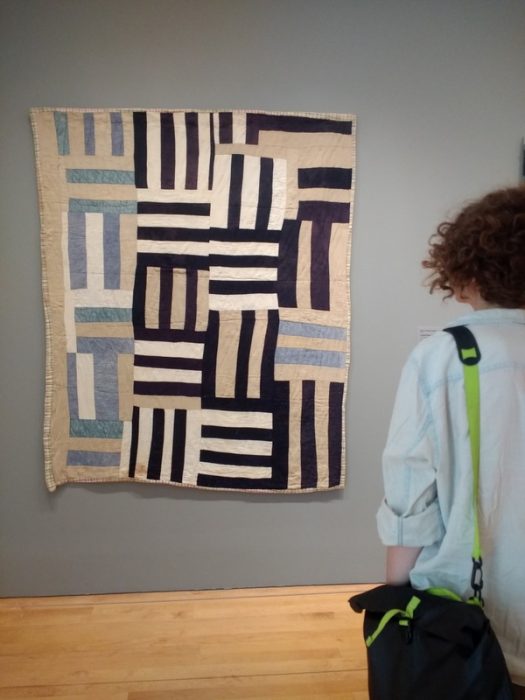
Roman Stripes (I’d call it Rail Fence; the maker calls it Crazy Quilt), Loretta Pettway, 1970

From an interview with Loretta Pettway: “I didn’t like to sew. Didn’t want to do it. I had a handicapped brother and I had to struggle. I had a lot of work to do. Feed hogs, work in the field, take care of my handicapped brother. Had to go to the field. Had to walk about fifty miles in the field every day. Get home too tired to do no sewing. My grandmama, Prissy Pettway, told me, ‘You better make quilts. You going to need them.’ I said, ‘I ain’t going to need no quilts.’ But when I got me a house, a raggly old house, then I needed them to keep warm. We only had heat in the living room, and when you go out of that room you need cover. I had to get up about four, five o’clock, and get coal. Make a fire. Them quilts done keep you warm.”

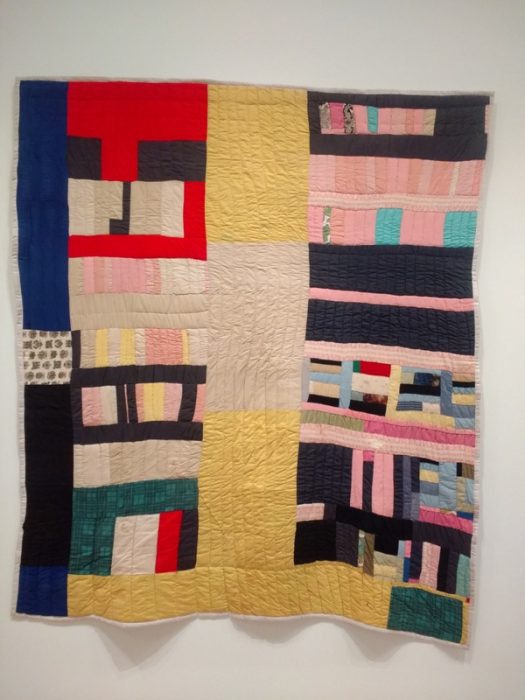
String-Pieced Blocks and Bars, Sue Willie Seltzer, using cotton, denim, and flannel, around 1965
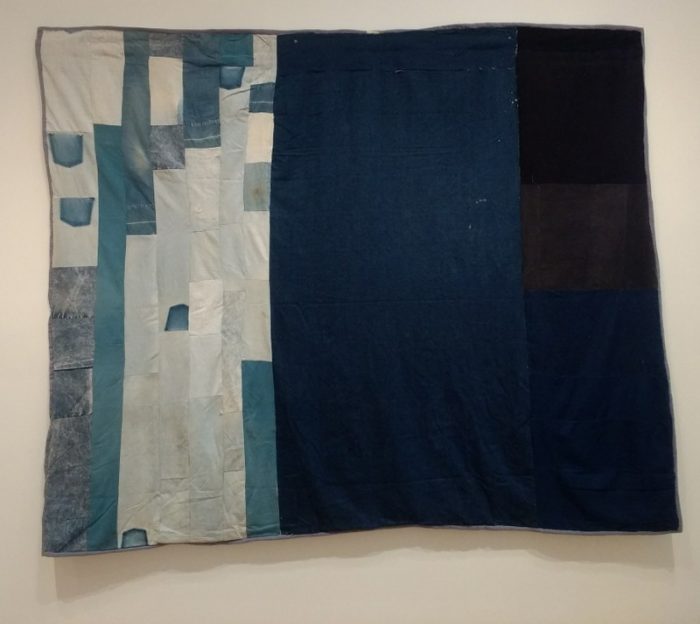
Blocks and Strips Work-Clothes Quilt, Andrea Williams, 1991
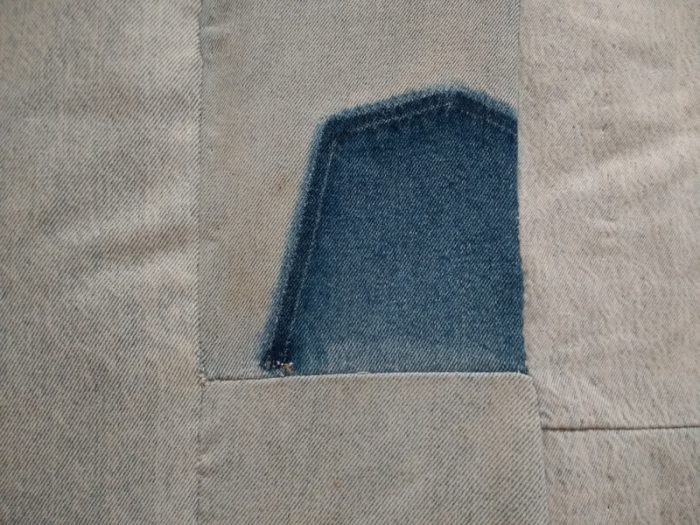
This detail shows the seamed together fabric from well-worn blue jeans, a pale color everywhere except where a pocket once kept the dark denim from fading.

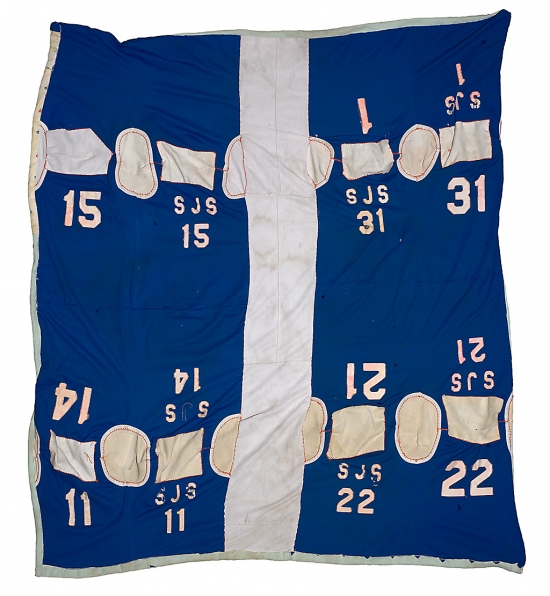
Like all the women in the show–and for that matter, in Gees Bend, Irene Williams has lots of quiltmaking relatives and neighbors. However this particular woman seems to have stitched to her own aesthetic. Since the age of 17, quiltmaking has been for her a solitary activity, a relief from working the cotton fields and raising six children. She explains, “When I got married, I started making quilts. I just put stuff together.” Among that “stuff” were basketball jerseys she pieced into a quilt top. Art critics delight in the whimsical way this work recalls maps with housing plots and numbers — or reflects a sly sense of humor.

Strips, Irene Williams, 1960s

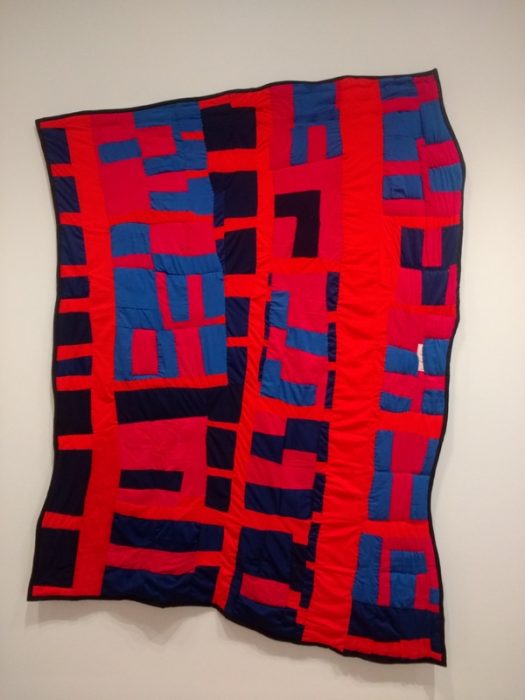
Irene Williams also created the piece below. Here, too, she used what she had, which obviously included a good deal of polyester knit. Using such a fabric means you get lots of stretching — distorted seams, puffy texture, and wavy edges. But you also get intense color, an iconoclastic shape, and a bold, attention-grabbing graphic that made this the image used to represent the entire Souls Grown Deep exhibit for the Philadelphia Museum of Art promotional materials.

Blocks and Strips, Irene Williams, 2003

I recently led a group on an informal tour through the exhibit, sharing what I knew and listening to their reactions. Each person chose her favorite, and this one was selected by several. My charges also asked how fame had affected their lives. This article explains it best. Many of the quilts originally sold for $75 when the maker thought that was far too much. Or, later, for hundreds of dollars when the value was listed in the thousands. Some quiltmakers cite the satisfactions of recognition and newly installed indoor plumbing, the occasional air conditioner or heater. The Souls Grown Deep Foundation engaged the Artists’ Rights Society to secure for each maker her due: intellectual property rights; copyright fees that are owed for use of the images, remuneration for the work of deceased artists finding it’s way to the rightful next-of-kin. Some of the Gees Benders are grateful, others have engaged in long, drawn out lawsuits in which money is consumed by the plaintiff’s lawyers.

Quilts have put Gees Bend on the map. But it is still a small, poor community.

Mali Medallion

Monday, August 12th, 2019

It’s my favorite thing: art quilts as advocacy.

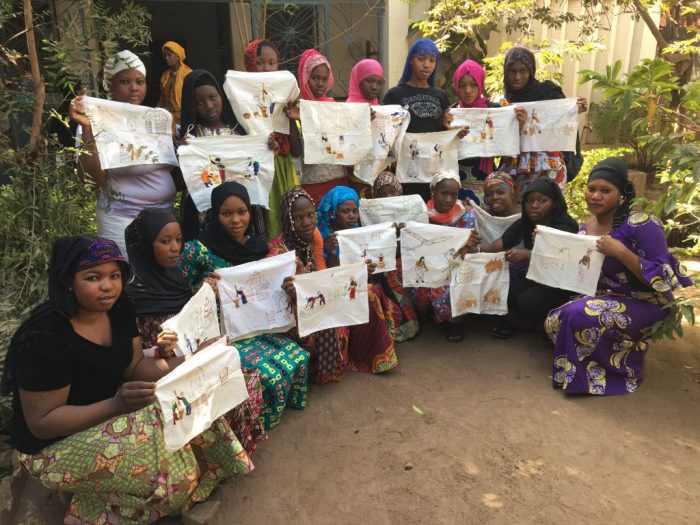
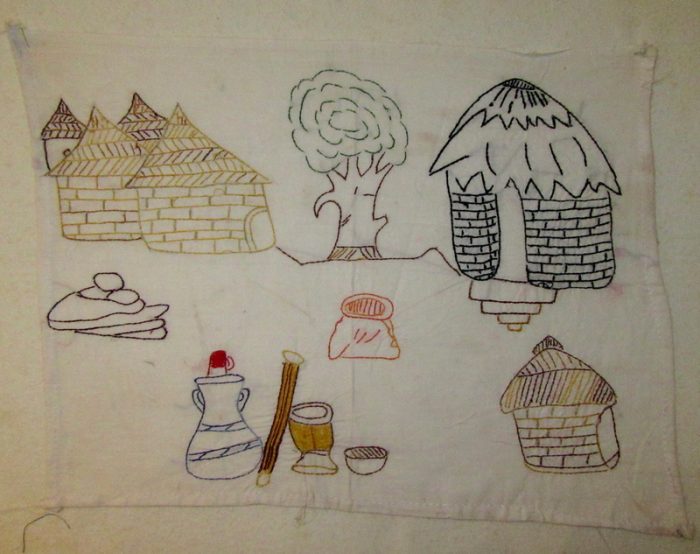
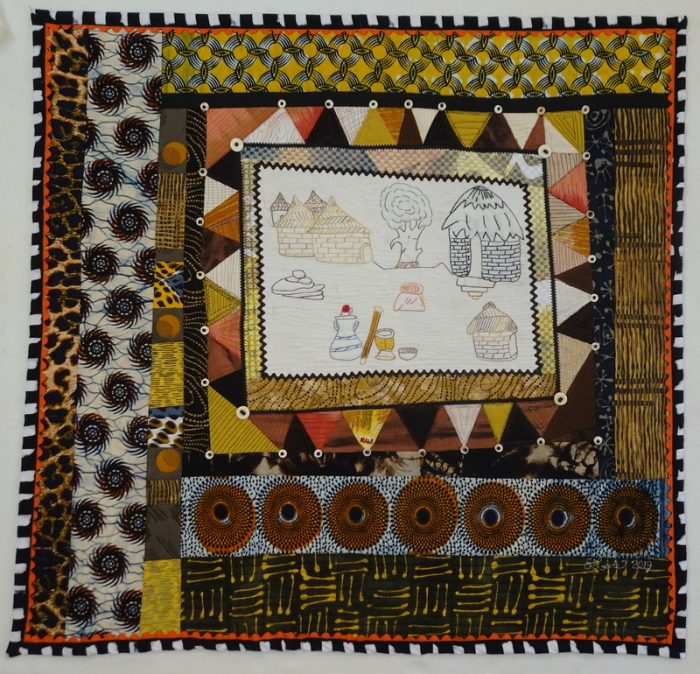
So I was quick to answer the call from Quilt for Change and The Advocacy Project. Under the initiative, known as Sister Artists, survivors of gender-based violence created embroidered blocks depicting scenes of their life in Mali. Quilters — mostly American — were invited to choose a block and turn it into an art quilt. The plan is for the quilts to be posted online, exhibited, and auctioned. And then all proceeds will go to support the artists in Mali and Sini Sanuman (“Healthy Tomorrow”), a Malian advocacy program for women’s rights.

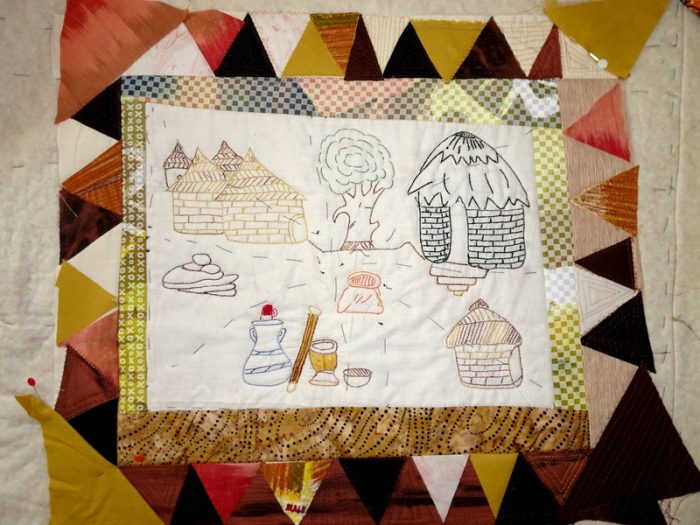
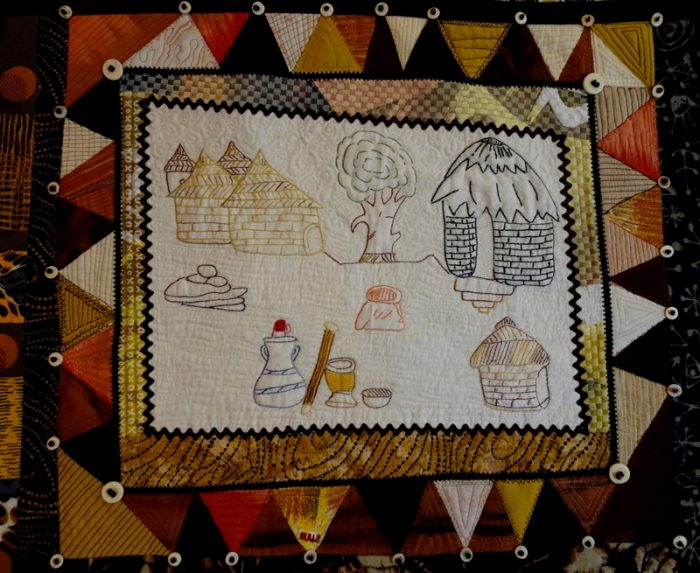
That sounded totally worthwhile to me. I especially liked the roundhouses on the block shown at the upper left, and below. For reasons of safety and policy, the young woman, i.e., Sister Artist, may not be named. Nevertheless, my priority was to honor her and her work.

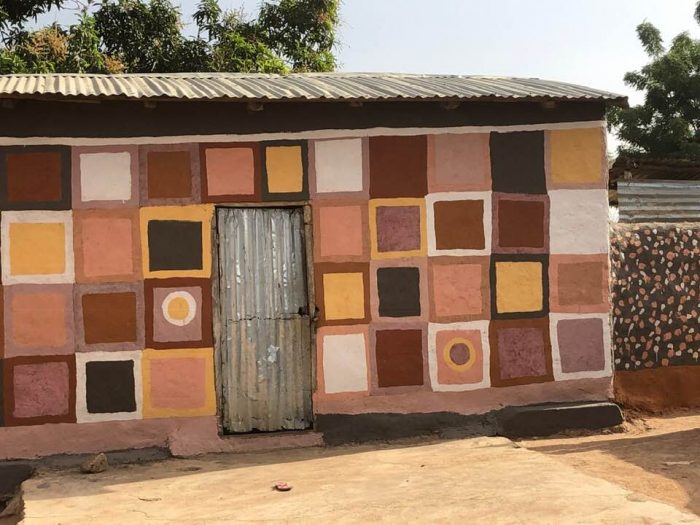
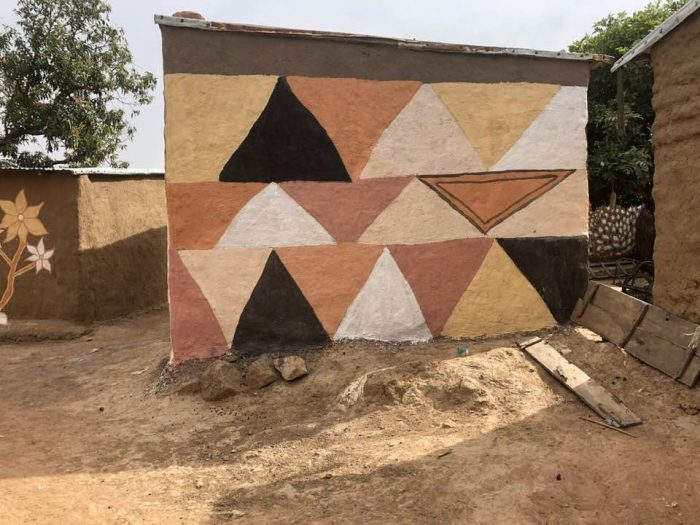
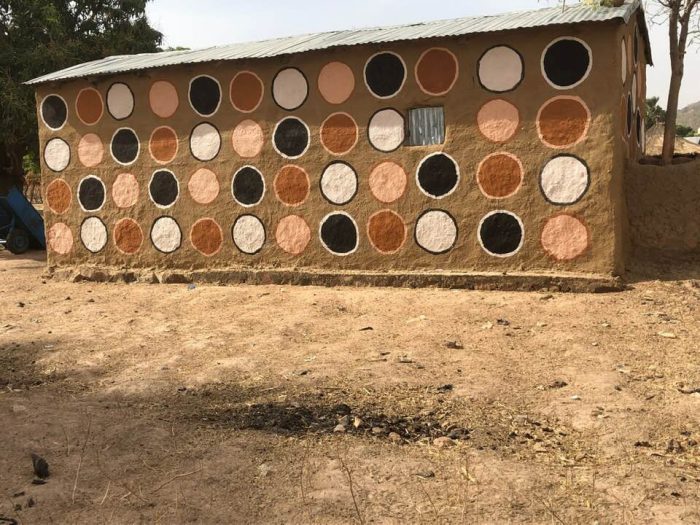
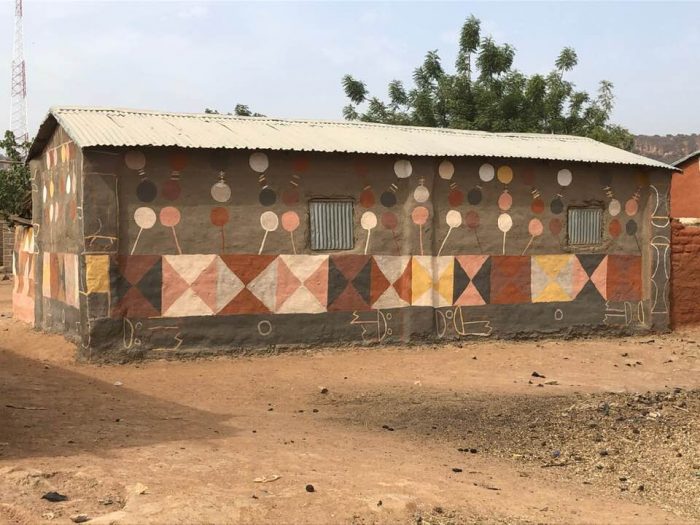
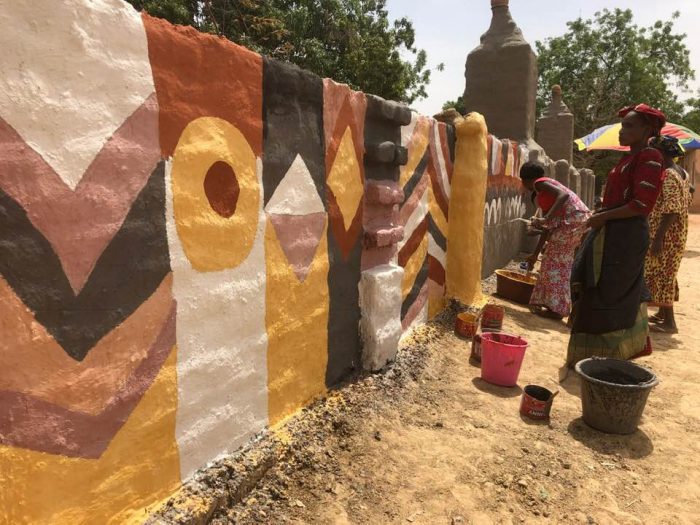
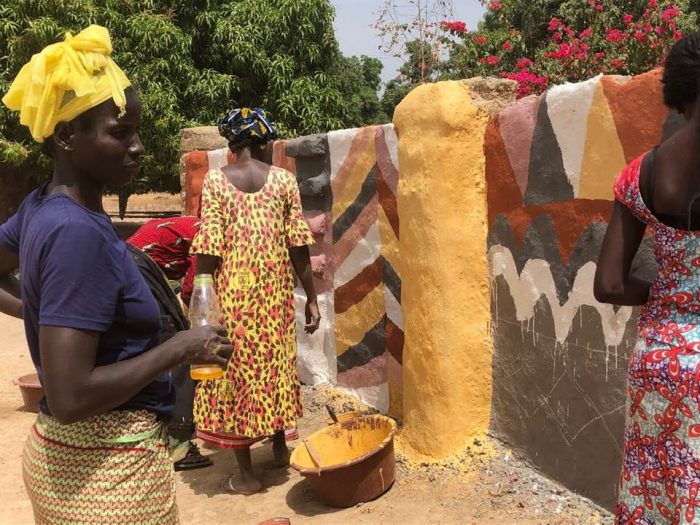
I immediately envisioned the lovely, pictorial embroidery surrounded by geometric designs used in Mali villages. A good friend, artist Janet Goldner, visits Mali quite frequently, and shared pictures she recently took of a house painting festival that takes place once a year in Siby, a village about 30 miles from Bamako (the capital and largest city in the country). Women draw from the local clay colors for their color palette. Wow, right?! So with the embroidery at the heart of my art, I set out to build around it, log-cabin-style.

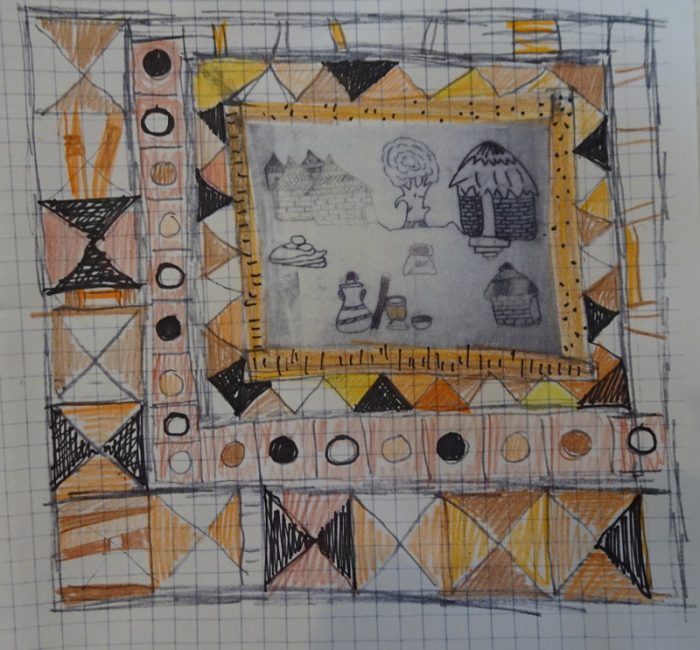
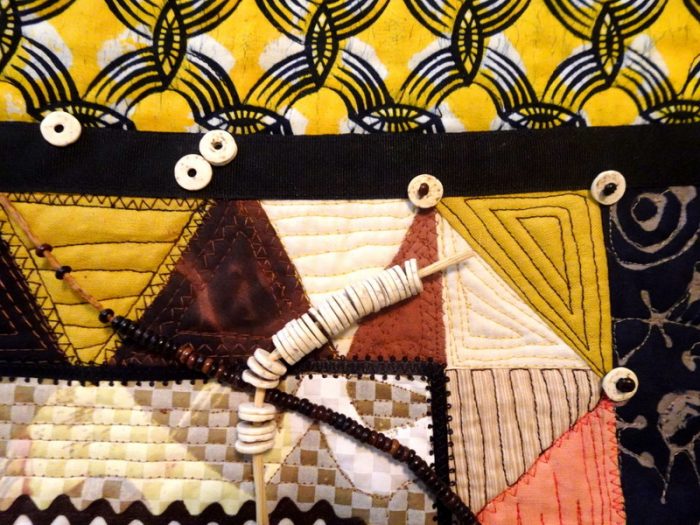
The embroidery background was not square, so I went with an assymetrical medallion setting, sketched out on graph paper. Now, I invariably depart from my original plan fairly quickly, but this time — surprise, surprise — I basically stuck to it. Oh, I didn’t keep to a specific scale, nor did I measure, cut, and sew precise patchwork or applique circles as dictated by the sketch. Instead, queen of the quick and dirty that I am, I used freehand-cut fused triangles and patterned fabric from my stash of African, batik, and hand dyed and printed fabrics. There was quite a bit of seat-of-the-pants fudging-it as I added rounds of borders. Conveniently, African beads camouflage spots where angles and corners lack sharp points.

I hope my piece does justice to the embroidered block. I hope it calls attention to the need for human rights, justice, and equality in Mali, as they are needed and deserved everywhere in the world. My efforts here are a small show of support, relatively insignificant. If I could, I would pin a medal on each courageous woman anywhere who struggles and strives and supports her sisters. For now, my Mali Medallion will have to do.

My Glorious Prints

Saturday, August 3rd, 2019

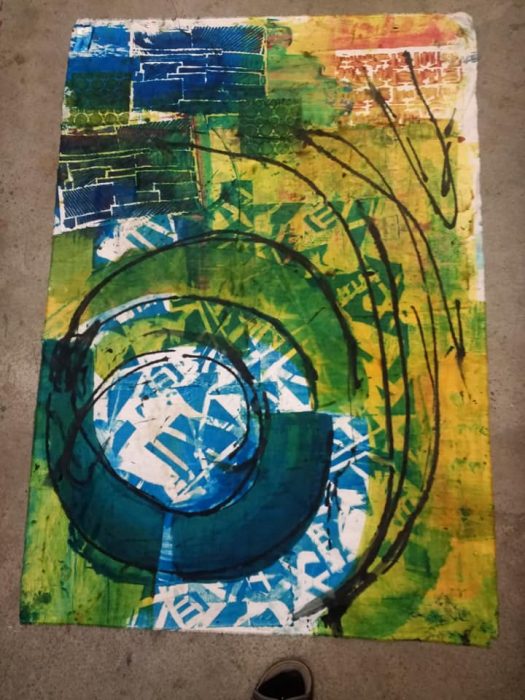
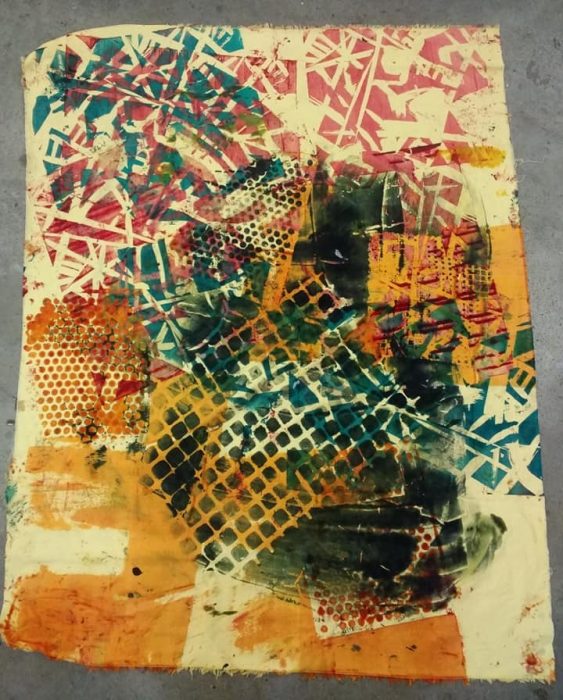
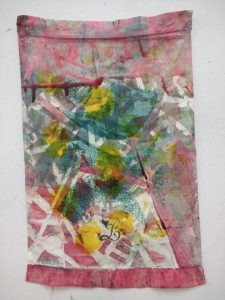
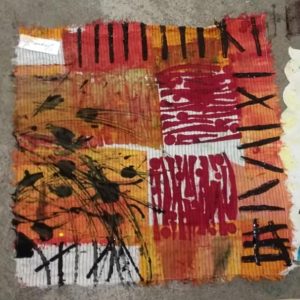
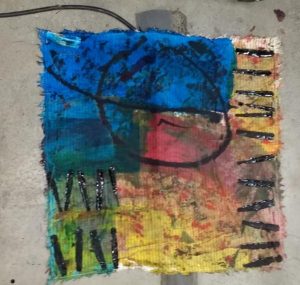
Glorious Prints is the name of a Pat Pauly class which was one of the most exciting art-making experiences of my life. See my previous blog post here. With Pat as your teacher, demo-ing her techniques twice a day over 4 1/2 glorious days, and with plenty of space to work and to spread out pieces to dry, you, too, can produce yards and yards of fabrics featuring exciting, large scale prints in the colors you love. Here are a few of the pieces I squeegeed, stenciled, spattered, dribbled, and silk-screened at Quilt & Surface Design Symposium in Columbus, OH the week of Memorial Day, 2019.

Big piece–see my foot! I’ll add a few strips at the bottom and call this an almost wholecloth art quilt!
Another big piece–printed on yellow fabric. I’ll definitely cut this one up.
Printed on a vintage tea towel. This will be a background for applique and embellishments.
Printed on a linen napkin. Will be fun to quilt as a little work.
Also printed on a linen napkin. I love how the electrical cord on the floor flows out of the design, and I’ll be extending that line with a satin cord onto the fabric that serves as a background, border, or picture mat.

I’ll try to add more of what came out of this class, and what I do with it. Hopefully in the next few weeks…

P.S. For that to happen, first I must pray to the Creative Spirit for the power to ignore housework, chores, family and volunteer commitments, deadlines, crises… Sometimes, I think a power outage would be a nice surprise. Get me off the computer, and in front of the design wall…. Oh, but then there’s that “Be careful what you wish for” caveat… How much would I actually be able to do this August without AC or a fan?!

Pat Pauly: House Tour!

Thursday, August 1st, 2019

The always vivacious, irrepressible, and dare I say it, totally lovable Pat Pauly: Exuberant doesn’t begin to describe her, or her richly textured art quilts, which appear in THE most distinguished shows, private collections, and books about art quilts.

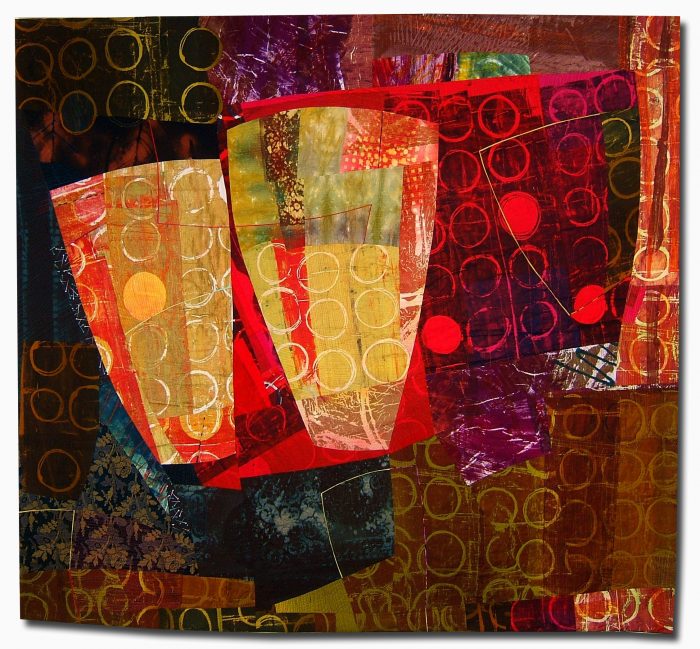
Mummy Bags, Canopic Jars, 66″ x 56″

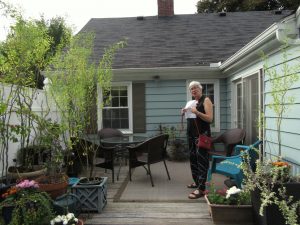
So you can imagine how thrilling it was for me, when I was in Rochester, NY last fall, to get a tour of her house. And now you can, too. The front is charming and neat, but friends come in through the back door. 

Pat painted the clapboards of the exterior — she painted the interior, too. Installed cabinets, refinished furniture. A gardener, she planted all the containers, trees, and flower beds. What that means is that, just like with her fabric-printing and art-quilting students, she establishes the ground rules, guides their development, then lets them loose to do their thing. 

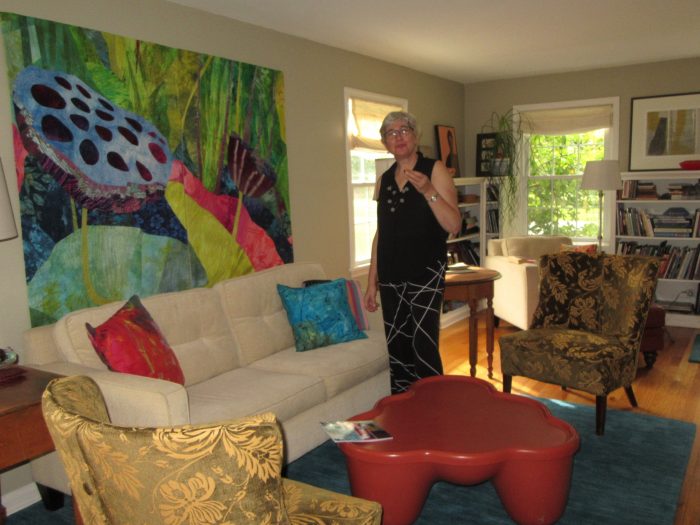
Flowers, or rather, lotus pods command the big diptych which dominated the living room when I visited. This, however, is a space where Pat rotates her giant (relatively speaking) masterpieces. The throw pillows are her work, too. Hot tip: Pat sometimes jumpstarts the process, beginning with linen or cotton ready-made covers which she squeegees and marks with thickened dyes. High-style soft spots that unify the color scheme of the exhibit du jour.

Other corners of the house showcase a cool mix of antiques, vintage, and modern, spare groupings of souvenirs, tchotkes, and art by friends. But it’s her own work, even with smaller dimensions, that invariably captivates your attention. Like the one shown below, Pat’s signature style of layering visual textures in strong, large-scale patterns make for abstract art that seems devilishly complex. Yet she will often produce 40″-squares following her own “Take Two” workshop technique, cutting and combining just two pieces of fabric. 

Pat wouldn’t let me take pictures of her basement studio, where she does the messy work of printing on fabrics as well as the improvisational piecing and free-flowing free-motion quilting. Not a ton of space, but suffice it to say it allows her to be her authentic, whirlwind self and create a prolific body of work. Especially remarkable, given the demanding pace of her teaching gigs. She should bottle and sell that energy, if not that talent.

Lucky me, I had the incredible thrill of taking two classes with Pat at QSDS earlier this summer: Glorious Prints, and Take Two. If you hunger for art, inspiration, or adventures in surface design or composition, she’s the teacher you want— PatPauly.com. Check her calendar and see if it meshes with yours. Attend a presentation or program or workshop, and you’ll probably get the opportunity to purchase her gorgeous fabrics. Oh, and if you want the inexpressible pleasure of living with her art, salivate over her portfolio on that website.

After blogging about Pat Pauly, you may find I have some nerve showing you some of the fabrics I created in her workshop…in my next post. Gonna do it anyway…